Haku Leleiohoku
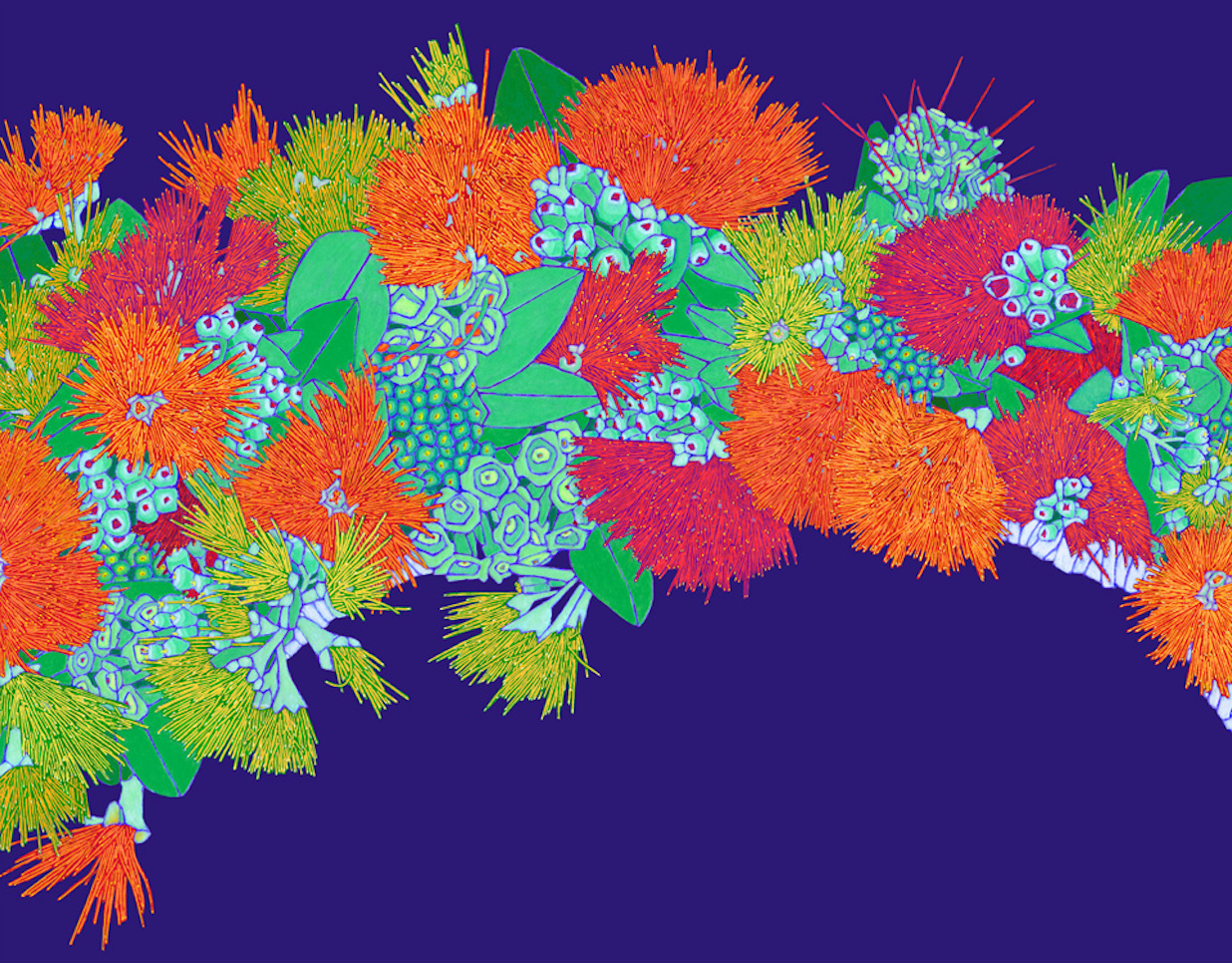
“ʻŌhiʻa Lehua” by Judd Boloker
Pua ka wiliwili nanahu ka manō. “When the wiliwili blooms, the shark bites.” My love, it’s true that when Leleiohoku blossomed, his immaculate stanzas and insurmountable quatrains haunted my imagination, like rows of glistening shark’s teeth.
Yes, it’s true: the lines I gave you, the ones you loved so dearly, were forged in another man’s heart. I approached their lyrical brilliance like a shark circling in ever-tightening circles. And then, I committed a teacher’s penultimate sin: I plagiarized my student’s work.
I do not deny that I have always possessed this shark-like nature.
But I defend my larceny with platitudes: Don’t the best poets steal? And isn’t everything fair in love and war?
Who was Leleiohoku? He was the wiliwili blossom, a rare flower born upon the dry, unyielding slopes of Makakilo. By an act of fate or the foresight of ambitious parents, he and his three siblings had inherited the names of the royal composers: David Kalākaua Freitas, senior and scholar-athlete-in-chief (being both student body president and captain of the football team); junior Lydia and sophomore Miriam, accomplished synchronized swimmers and National Merit Scholars (who would one day dedicate their Olympic silver medals to Senora Hill, an indelible source of inspiration). And then there was William Pitt Leleiohoku Freitas, the youngest of the four, a shy, unpresumptuous freshman who, unlike his older siblings (and to his parents’ private dismay), cared little for formal accomplishments, but who was perhaps the most gifted of them all.
Collectively, they were bestowed the lofty title of “Na Lani Eha" the year all four were Song Contest Directors. Beneath the bright lights and a mountain of fragrant leis, each Freitas mounted the pedestal and summoned forth their respective army of angelic voices: green then blue, red then purple, 400 synchronized voices crescendoeing and decrescendoeing with each sweeping gesture into the shape of church bells and brave voyages, and a thousand inconsolable emotions.
It is hard to describe the small miracle of Leleiohoku’s performance. Beneath pitch-perfect thirds and each meticulous modulation trembled an untamed energy that rolled over the crowd like a winter swell traversing the Pacific Ocean. Through the second miracle of broadcast television, it was pinged up into space, up through the tropo-strato-mesosphere into the oxygenless realm of satellites and seraphims orbiting earth; and then it came crashing back down again, filling our t.v. sets with its alien beauty.
When all was said and done, three of the four judges produced identical scorecards. The fourth judge, a petulant man who despised the idea of ties (believing them antithetical to excellence), anointed the Senior class victors by the slimmest of margins. All left that night recalling Leleiohoku’s brilliance.
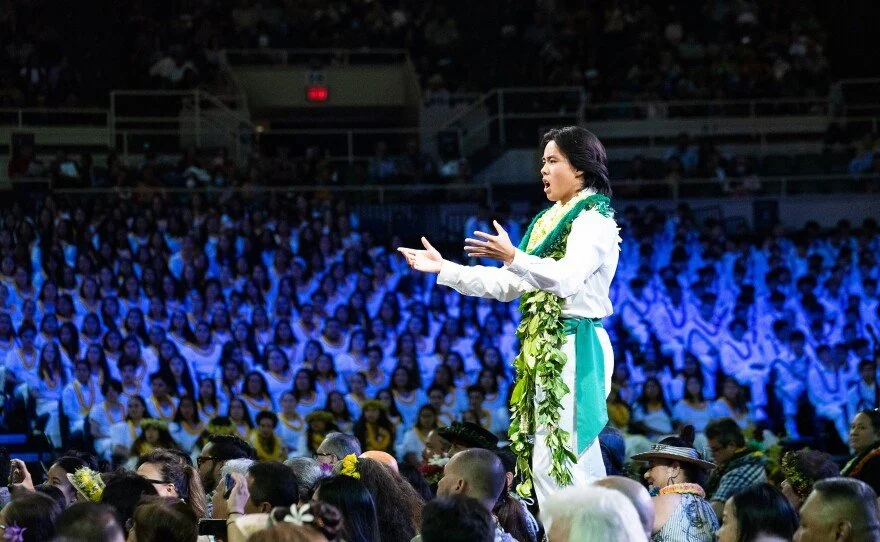
Photo Credit: Hawaiʻi Public Radio
* * * * * * * *
From day one, a radiance emanated from Leleiohoku's poetry. It was the product of an infinite imagination and an unnatural appetite for verse. The young prodigy consumed canons with impunity: Basho for breakfast, Li Po for lunch, seven Shakespearean sonnets before supper; a fortnight of Keats was followed by an anahulu of Auden; and when time would allow, a nightcap of Neruda the hour before drifting asleep. His intestinal depths delighted in this moving feast, digesting the swirling poetic stew of continents and centuries that mapped the luminous geography of the human heart. Inevitably, a spontaneous inspiration would take root, and something new and brilliant would emerge (perhaps he was the shark and the poems were the wiliwili blossoms).
His singular passion was love poetry, which he composed with a fierce urgency. Its inescapable truth was arrived at through the unyielding knowledge of his ill-fated predecessor: imagine young Leleiohoku standing before the crypt of his royal namesake at Mauna Ala, imprisoned in thought. A gentle rain falls, touching everything with the promise of life. What dissonance for such a poetic soul!
To escape the specter of death, he occupied his mind with Sisyphean tasks. Over and over, he reanimated the haunting love songs of his predecessor into the bodies of impossibly difficult poetic forms. The exquisite corpse of “Ke Kaʻupu” became a Petrarchan sonnet before being reincarnated as a sestina. “Nuʻa o ka Palai” through careful labor was reborn an elegant ghazal. With each arrangement, the young prodigy conquered death for a fleeting moment. Or rather, through love, he quelled his fear of death. He wondered how one could ever truly love with complete sincerity, yet its sheer impossibility confirmed its truth. And so, perhaps in his imagination, Leleiohoku viewed himself as the fragile wiliwili blossom.
* * * * * * * *
To return to those singular love poems. I have been accused of theft by my enemies. In truth, they were a gift, a poetic hand-me-down given to me after serving their original purpose. A poem is a vessel that carries many lives (and many secrets). The poems I have given you were born on a warm Wednesday afternoon, in chapel, from the loins of Leviticus 18:22.
“ʻThou shalt not lie with mankind, as with womankind: it is abomination.” The kahu repeated the words once more, hoping to secure it in the hearts of his young congregation. His voice, as always, was filled with eternal warmth. Leleiohoku, meanwhile, tried his best to fan away the stifling heat. Or perhaps he was fanning away the kahu’s words, for Leleiohoku had known for a long time that he was just such an “abomination.” Once upon a time, he felt shame in it. But that was long ago. Instead, the stifling heat triggered an equal and opposite reaction in him. He began to lay out his vision for a PRIDE Club at Kamahaʻo Schools. The school’s namesake, the Mōʻī, had male aikane, after all; and there were countless verses describing Christ’s boundless love for the least among us. The next week he presented his arguments to the Administration, but the uncompromising spirit of the Old Testament prevailed. Leleiohoku’s proposal was rebuffed by the headmaster, who always deferred to the spiritual counsel of his kahu.
* * * * * * * *
The following week, a sealed envelope arrived at the kahu’s door. It was early morning. When he opened it, he found a folded poem nested within. It was a love poem. It seemed harmless at first, resting there in his hands. His heart, through years of pious devotion, had wholly committed itself to God: what little space remained had been faithfully committed to his loving wife. Still, he delighted in the unexpected adulation. For an hour he folded and unfolded its contents in the privacy of his office, imagining who his secret admirer might be. Perhaps it was Ms. Thompson, the cheerful math teacher who always sat in the front row, just within his field of vision. She always nodded appreciatively at his sermons. Or perhaps it was one of the many young souls who filled his pews each week; a shy student who, in her impressionable youth, confused his passionate preaching with the more earthly manifestations of God’s love. Regardless, it was a sign of a job well done.
Each morning a new envelope arrived, greeting the kahu with its precious cargo. To his disbelief, the second poem was twice as beautiful as the first. Its couplets conjured into existence two white terns soaring high above Kawaiha‘o Church. Kahu floated in its luminous presence all morning: how surprising the way a handful of words could ignite his entire being. That afternoon he gave an inspired sermon, perhaps the best of his career. That night he carried his wife to bed with the same youthful industry of his wedding night.
It was the third poem that troubled him. Yes, it was even more beautiful than the first two combined. But a subtle slip of syntax in the last stanza revealed the gender of his anonymous paramour. He read and re-read the poem to be absolutely sure. Each time his eyes collided with that innocuous line of two lonely ships passing in the middle of the night, his heart trembled, pierced by the sharp reef of truth submerged beneath the surface. Poor kahu. He began to take on water and sank deeper and deeper into despair. Kneeling before the chapel altar, he called out to God, begging Him to banish the poems from his imagination. I ka ‘ōlelo no ke ola, i ka ‘ōlelo no ka make. Yes, these words had the power to destroy him. He repeated Leviticus over and over as if the words were an antidote that could inoculate him from his deepest fears. But the poems were filled with such undeniable truth that when the fourth envelope arrived, he could not abstain from opening it. And as he read the poem, somehow even more brilliant than the last, he felt, against his will, his heart soften. The words reverberated through his body like the trumpets at Jericho. It shattered his fortress heart. Within a week he had fallen hopelessly in love.
How was this possible, you may ask? How could this reviled seed take root in the guarded chambers of the kahu's heart? My love, such miracles have always occurred in our islands. According to our best botanists, it occurred with the clockwork efficiency of once every 98,000 years. The primal seed that survived doldrums by clinging to a piece of flotsam, or overcame the dark night of a tern’s stomach to arrive on these shores, is living testament to this truth. Why are we surprised when love, the most powerful seed of all, takes root in the human heart?
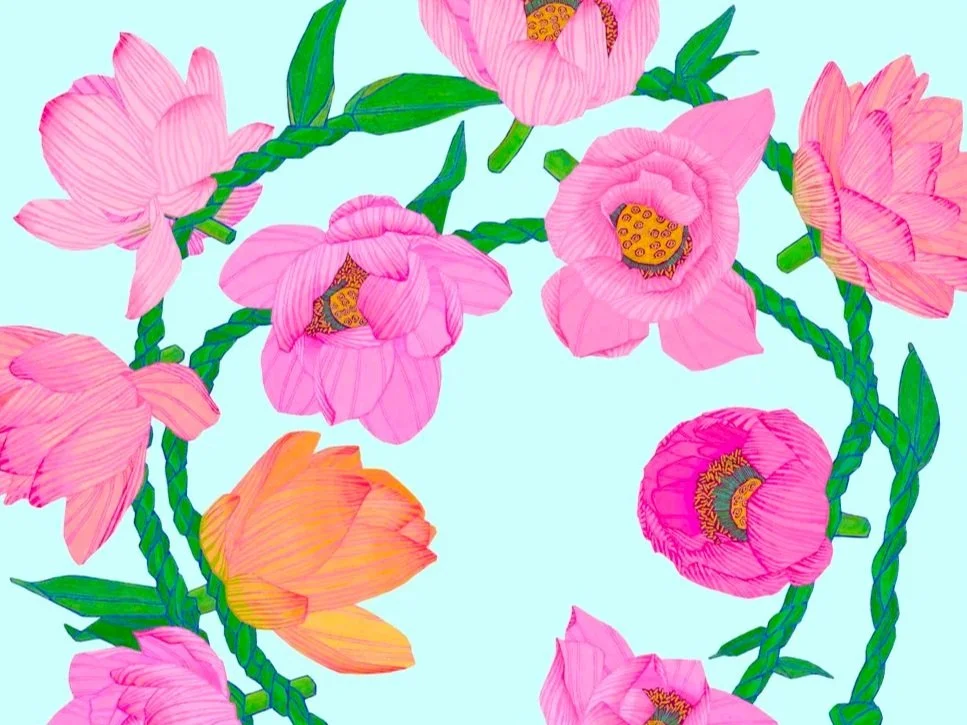
“Lei Laʻi Hilo with Lotus Flowers” by Judd Boloker
For weeks the kahu battled the demons in his heart. And yet he found himself arriving to work earlier and earlier each morning until one morning he looked up and found himself in the crepuscular dark before the chapel door. The sealed letter would be there waiting for him. The kahu fretted. He lost sleep and began to skip meals (which worried his faithful wife). At night, he locked himself in his study and reread those intolerable poems. God saw him and his trembling desire. The knowledge of His omnipresence further tortured the poor kahu. And yet, when he walked around campus, everything reminded him of the poems, for the world and his heart existed within them: the moon, the birds, the wind passing through the trees, the burning warmth of the sun. He mumbled the verses like prayers; through sheer repetition, he committed entire poems to memory. Sometimes a rainbow would appear, reminding him of his broken covenant with God. Other times he thought he noticed birds eyeing him hungrily, having detected the forbidden seeds in his heart. For forty days and forty nights he wandered in his desert without reprieve.
And then one morning, the letters stopped. The kahu sighed with relief. He had survived God’s test, he told himself. For the first time in forty days, he slept beside his wife with profound peace. But the following week, a new desperation took root, infiltrating the fabric of his dreams. They were haunted by monstrous rainbows that hovered and arched above his head like horrifying halos wherever he went.
This was the state of poor kahu the day the last poem arrived. The kahu’s heart raced. He looked sheepishly to his left, then to his right; he glanced over his shoulder. When he opened the envelope, he let out a sigh of relief: it was not a new poem, but a familiar verse from “Kāua i Ka Huahuaʻi,” the original Leleiohoku’s most famous and well-recognized song. It was unadorned and unembellished by his captor’s touch.
That afternoon, on the last chapel service of the year, kahu introduced Leleiohoku Freitas, a quiet freshman who had been selected by his peers to speak before the class. He ascended the pulpit and nodded kindly to the kahu. Then he smiled at his peers, who responded to his quiet confidence, just as they did the night of Song Contest.
“I am humbled to be here with you in this house of love.” Even when speaking, the boy’s voice was a thing of beauty, a joy forever.
“In John 4:16 it says, ‘And we have known and believed the love that God has for us. God is love; and he that dwells in love dwells in God, and God in him.’ I believe in the greatness of God’s love. It exceeds our imaginations. It is the foundation of my faith. God is love, and our ability to love is what brings us closest to Him. From time to time I have tried to express my thoughts and feelings in words. They are far from perfect, but I would like to share several of my failed attempts with you today.”
Leleiohoku began to recite his words. The kahu’s dismissive smile evaporated when he recognized each of the lines from the poems he had memorized. Perspiration assailed his forehead. His tongue cracked, his ears pounded; slender fire burned under his skin.
“I would like to end with a song from a poet much greater than I. It comes from my namesake, who lies near our beloved Princess at Mauna Ala.”
Leleiohoku began to sing. With each verse, his voice ascended the four octaves like a cool fountain:
Kāua i ka huahua`i
E `uhene lā i pili ko`olua
Pukuku`i lua i ke ko`eko`e
Hanu lipo o ka palai
The girls sighed. Ms. Thompson cried, nodding her head approvingly.
All at once, the seeds that were poems blossomed in kahu’s heart. A garden of wiliwili emerged. Other flowers bloomed too, until a rainbow of breathtaking flowers filled the chambers of the kahu’s heart. Poor kahu. He was, in that moment, the wiliwili blossom, and Leleiohoku, the shark.
* * * * * * * *
I went home that day thinking of the miraculous garden of poems, marveling at their intricate pattern and their creator’s inescapable prowess. Somehow, they seemed to mirror the difficult journey of our own love, with a type of breathtaking symmetry that is perhaps the nature of all good love poems.
Perhaps Leleiohoku felt compassion for poor kahu as he descended the pulpit. Perhaps not. I would like to think that these poems, his gift to me, was a subtle act of penance, knowing or sensing my own desperate situation: driven not by a self-serving desire to absolve his own feelings of guilt, but by an unspoken feeling of shared humanity.
I would like to think that, in the greater scheme of things, Leleiohoku’s poems were always destined to arrive at our shores: to be reincarnated into the center of our lives, like a measured ray of hope.
My love, with each fight, each reconciliation, we have woven our lives closer and closer together. We have collected seeds in our hearts, drifted through darkness and doldrum, waiting to bloom.
Kāua i ka huahua`i
E `uhene lā i pili ko`olua
Pukuku`i lua i ke ko`eko`e
Hanu lipo o ka palai
My love, I have always desired you, the way the shark desires the wiliwili blossom.
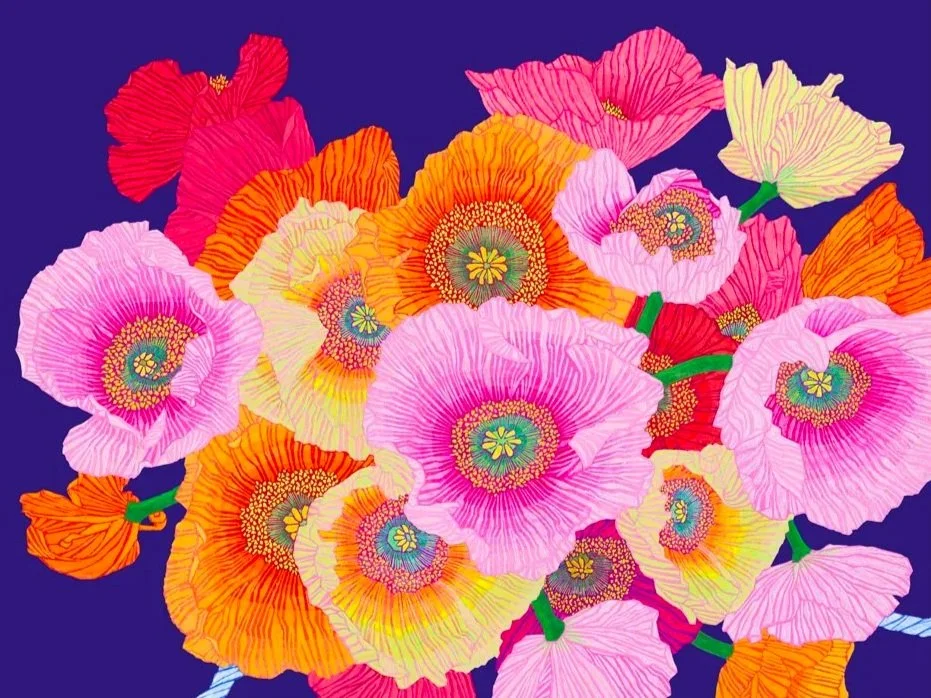
“Icelandic Poppy x Kingdom of Hawaiʻi” by Judd Boloker